


Addressing Climate Change
Recognizing that the sustainability of society is a key item in its business activities, the Bandai Namco Group has established a framework that enables it to make decisions and implement sustainability initiatives more swiftly, and is actively advancing initiatives.
We formulated the Bandai Namco Group Sustainability Policy in April 2021 because addressing climate change is essential to realizing a sustainable society and ensuring the continued growth of our business. We also agree with the aim of the Paris Agreement to “keep a global temperature rise this century well below 2 degrees Celsius above pre-industrial levels and to pursue efforts to limit the temperature increase even further to 1.5 degrees Celsius.” In order to further accelerate our efforts to reduce greenhouse gas (GHG) emissions, we have established medium- to long-term targets for the transition to a decarbonized society. In addition, in 2021, we began disclosing information in line with the recommendations of the Task Force on Climate-related Financial Disclosures (TCFD). In September 2023, we officially announced our support for these recommendations. We also participate in the TCFD Consortium and strive to collect the latest information on climate change.
In fiscal 2024, we upgraded our scenario analysis to provide a more detailed understanding of the impacts of climate change on the Group. Specifically, in addition to future forecasts from external institutions, we used activity data from each business unit to assess the future impact on the Group for each of these units. Based on the results of this analysis, we will pinpoint the risks and opportunities that the Group should prioritize and strengthen our response going forward.
About the Formulation of Our Climate Transition Plan
The Bandai Namco Group has formulated a Climate Transition Plan to crystallize its policies toward transitioning to a decarbonized society and to further promote its actions to address climate change. This plan is linked to the Group’s Mid-term Plan (2025–2028) and aims to achieve both a decarbonized society and increased corporate value.
Fundamental Approach
The Group considers the reduction of greenhouse gas (GHG) emissions throughout its entire supply chain (Scopes 1, 2, and 3) as a way to strengthen actions against climate change.
Specifically, we will advance initiatives based on the following three main pillars:
 Promote energy conservation and introduce renewable energy at our own facilities
 Reduce GHG emissions in the supply chain
 Consider the environment regarding the use of plastics
In particular, regarding plastics, which are the main raw materials for many of our products, we are working to reduce their usage, utilize alternative materials, and promote recycling based on the Bandai Namco Group Plastic Environmental Consideration Policy. We consider these initiatives to be important measures that contribute not only to resource circularity but also to the reduction of GHG emissions.
Future Developments
The external environment surrounding climate change is changing rapidly due to stricter regulations and advancements in technological innovation. The Group will continuously monitor these developments and periodically review its Climate Transition Plan.
Based on dialogue with stakeholders and progress in initiatives within each business unit, we will enhance our scenario analysis and review various measures. We will enhance the effectiveness of our transition plan and promote a steady transition to carbon neutrality by ensuring accountability through appropriate disclosure of information regarding our progress and challenges.
Governance
Sustainability Promotion System
Decisions regarding the implementation of the plan will be made by the Group Sustainability Committee, which is chaired by the president and representative director.
The Group Sustainability Committee regularly monitors the progress of GHG emission reduction targets and environmental considerations for plastics set forth in the Climate Transition Plan. If there are delays in progress toward the targets, or if there is a discrepancy between the business growth strategy and climate-related targets, the committee has a process in place to promptly analyze the causes as well as discuss and decide on necessary corrective actions.
Regarding sustainability evaluations in executive remuneration, we are currently considering defining the weighting of non-financial indicators such as GHG emissions reduction in performance-linked remuneration and specific evaluation targets, in order to more clearly demonstrate management’s commitment to advancing the Climate Transition Plan. We will continue to improve the system going forward.

Role of the Group Sustainability Committee
Evaluation of implementation status and assessment of effectiveness
Within the Bandai Namco Group, each Group company is implementing measures in accordance with its material issues and tailored to the characteristics of its business. The results are analyzed for each fiscal year, for the entire Group and for each business segment, leading to improved measures for the following fiscal year and beyond. The results of analyses are discussed by the Group Sustainability Committee, and then reports are made to the Board of Directors, which deliberates and supervises as necessary.
The progress of each measure, including the Climate Transition Plan, is regularly disclosed through our integrated report and other media, comparing targets with actual results for the relevant period for each material issue.
Targets and results by material issue: Our Materiality > Targets and results
Collaboration system involving internal departments
To ensure the successful implementation of our Climate Transition Plan and to further integrate it into our business strategy, the Group is strengthening processes for collaboration between internal departments, led by the Sustainability Management Department.
We will work with the Investor Relations Department to build a company-wide system that directly incorporates investor feedback into the continuous review and improvement of our Climate Transition Plan.
Stakeholder Engagement
The Group is promoting engagement across the entire value chain to realize a sustainable society.
Engagement with customers, consumers, and suppliers
As part of our efforts to engage customers and consumers, we have created an infrastructure for resource circularity that consumers can directly participate in. We also leverage the unique business characteristics of the Bandai Namco Group to carry out educational initiatives through entertainment. Meanwhile, in terms of engaging with suppliers, we have established and are working to disseminate the Bandai Namco Group Code of Conduct and Bandai Namco Group Guidelines for Business Partners. We are committed to building a responsible supply chain by verifying a supplier’s initiatives in areas such as environmental conservation at the start of a business relationship.
| Purpose | Main initiatives | |
|---|---|---|
| Engagement with customers and consumers | Building infrastructure for resource circularity that consumers can directly participate in |
Installing collection boxes at amusement facilities and official shops |
| Educational activities through entertainment | ||
| Engagement with suppliers |
|
|
Engagement with governments and industry groups
With the aim of enhancing the status of the entertainment industry as a whole, the Group actively engages governments and others. In addition to the Japan Merchandising Rights Association, where our vice president serves as vice chairman, we participate in various industry organizations and advisory councils under the Ministry of Economy, Trade and Industry, and are actively engaged in discussions with relevant government agencies. We are working to achieve carbon neutrality in line with the goals of the Paris Agreement by participating in various initiatives and collaborating with stakeholders. Through engagement, we will continuously gather the latest information on climate change countermeasures and consider actions to make more effective use of the initiatives we are currently participating in.
| Purpose | Major memberships/initiatives | |
|---|---|---|
| Enhancing the status of the entertainment industry as a whole | ||
| Achieving carbon neutrality in line with the Paris Agreement targets |

|
Task Force on Climate-related Financial Disclosures (TCFD)Endorsed the TCFD recommendations in 2021 An international framework that encourages disclosure of the impact of climate change on corporate finances. |

|
GX LeagueParticipated since 2024 A framework for promoting Green Transformation (GX) through public-private collaboration to achieve a carbon-free society. |
|

|
Japan Partnership for Circular Economy (J4CE)Participated since 2023 A public-private framework to promote initiatives towards a circular economy. |
|
Strategy
Alignment with Business Strategy
The Group is promoting its core IP axis strategy to realize its Mid- to Long-term Vision, “Connect with Fans,” while also addressing environmental issues, including climate change, in line with business strategy. In particular, from the perspective of both enhancing the value of IP and products/services as well as realizing a sustainable society, the Group has identified material issues, and within them, “Harmony with Nature” and “Sustainable Use of Resources and Raw Materials” are positioned as key items. Based on these policies, as part of our specific initiatives, we have formulated policies to strengthen environmental considerations regarding plastics, and we are working to utilize alternative materials, expand the use of recycled plastics, and promote recycling.
Assumptions for Scenario Analysis and Identification of Risks and Opportunities
Because the external environment surrounding climate change is constantly changing, the Group regularly reviews and upgrades its scenario analysis based on the latest trends in each business and region. We will continue to closely monitor industry trends and global developments.
Details of scenario analysis: Our response to the TCFD recommendations (Strategy)
Strategy Execution Based on Scenario Analysis
To address identified risks and opportunities, the Group is implementing specific measures in each of our businesses. In our Toys and Hobby Business, in addition to using recycled materials, we are reducing plastic usage by introducing alternative materials such as eggshells, tea leaves, and bamboo, as well as by implementing innovative product designs such as capsule-less Gashapon. In our Amusement Business, we are developing and introducing Eco-Amusement Machines that meet certain environmental standards. In response to the risks posed by extreme weather, we are developing a variety of services, including virtual events that are not affected by weather conditions.
These low-carbon and environmentally friendly product and service offerings form an important portfolio for advancing our Climate Transition Plan. We will proceed with developing and reviewing our internal systems to formulate quantitative indicators and targets (KPIs) that will contribute to net sales and profits in the future and to what extent we will expand our business scale.
Funds Procurement Policy and Capital Allocation
During the Mid-term Plan period, the Group intends to allocate approximately ¥600 billion to growth investments and approximately ¥150 billion to strategic investments (“360 investments”) that look ahead to the medium to long term. Under this framework, we will implement capital investments and other measures aimed at business growth.
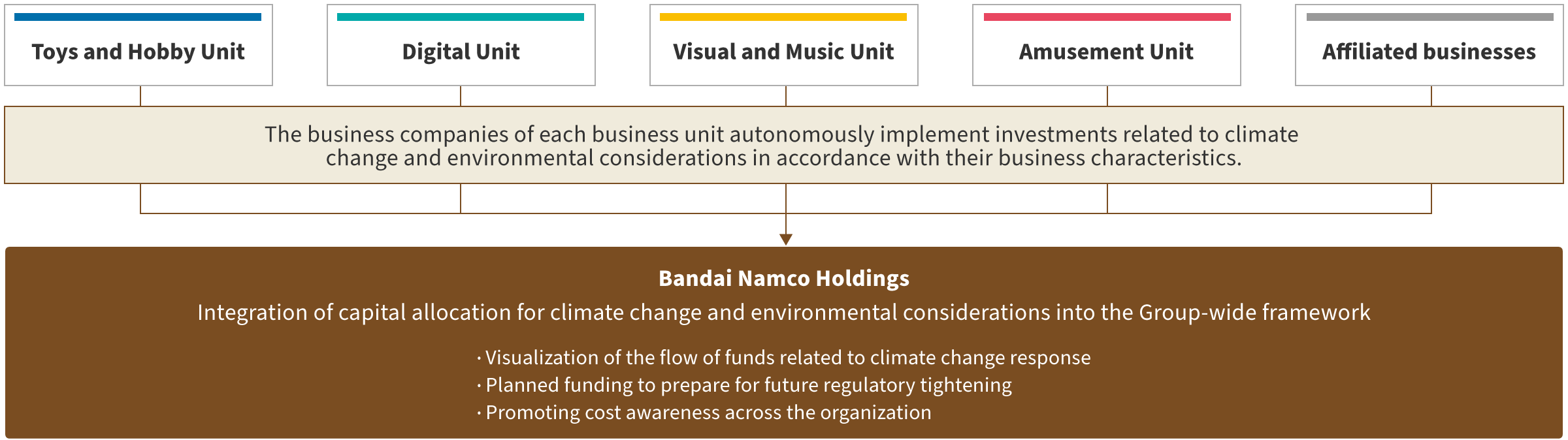
Our policy is to prioritize using the Group’s own funds as the primary source of investment capital needed to implement the Climate Transition Plan aimed at realizing a decarbonized society and promoting resource circularity. While each subsidiary autonomously formulates and manages its own budget, investments related to climate change countermeasures along with responsible use and disposal of plastics are also accounted for and executed as part of their business activities. Bandai Namco Holdings oversees the Group’s overall decarbonization policy and centrally manages and operates its financial management including carbon credit purchases. Going forward, we will work to improve the visibility of investments specifically focused on sustainability initiatives, and also examine the effectiveness of internal carbon pricing as a tool for strategic resource allocation and investment decisions in managing climate change-related initiatives.
Formulation of Carbon Neutrality Roadmap
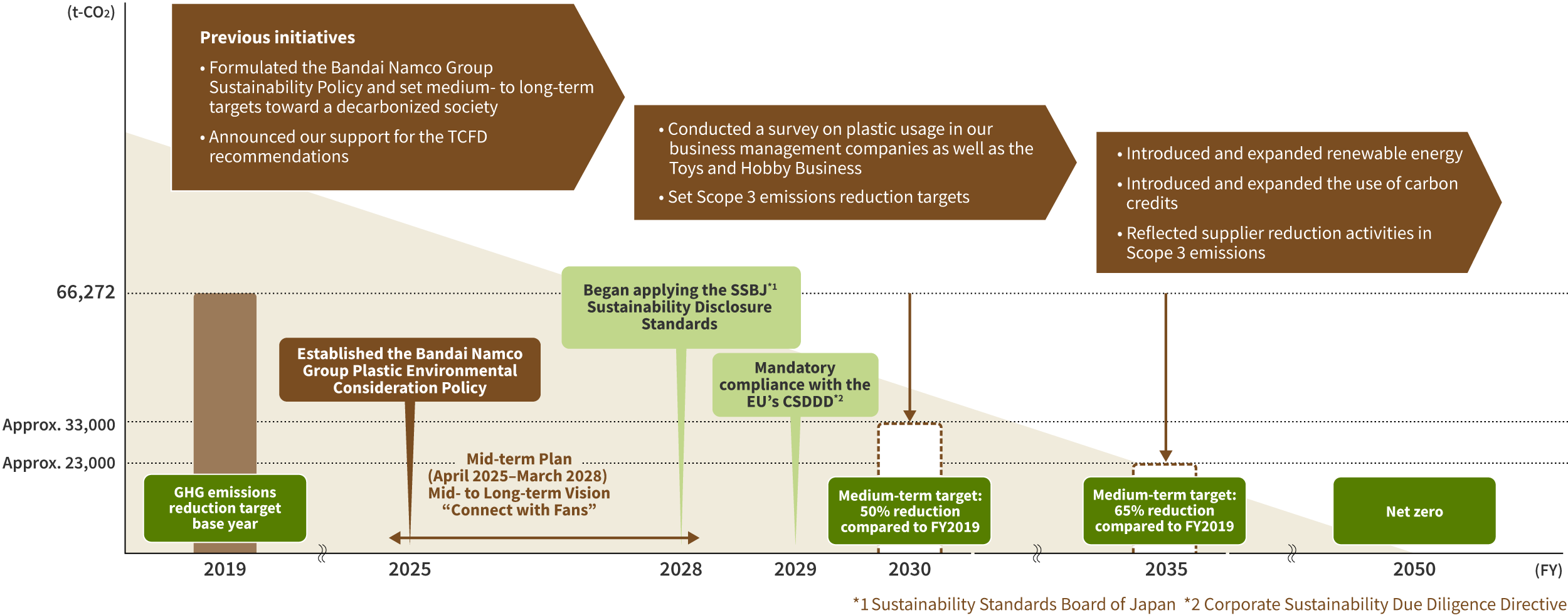
The Group has set GHG emissions as a KPI in order to appropriately evaluate and manage the progress of its ESG management and the impact of policy risks associated with climate change. Specifically, we have established interim milestones of reducing GHG emissions at our sites by 50% compared to fiscal 2019 by 2030 and by 65% compared to fiscal 2019 by 2035. Furthermore, by 2050, we aim to reduce the amount of energy-derived GHG emissions at the Group’s business sites (offices, own plants, directly operated amusement facilities, etc.) to net zero.
To achieve these goals, we recognize the importance of developing a carbon neutrality roadmap that ensures our emission reduction path is aligned with scientific evidence and the transition pathway for society as a whole. The Group will develop its own roadmap, taking into account the characteristics of its businesses, while referring to macroeconomic indicators such as the international 1.5°C target and national GHG emission reduction targets.
First, we will define an emissions reduction pathway for Scopes 1 and 2 emissions at our own facilities, and in the future, we will build a reduction plan that includes the entire supply chain (Scope 3). Going forward, we plan to gradually expand the content of our disclosures through updates to our Climate Transition Plan.
Risk Management
Process of Assessing and Managing Climate Change Risks
The Group Sustainability Committee discusses risks and opportunities related to sustainability, identifies material issues that the Group should address, and promotes sustainability activities throughout the Group. In this process, the committee cooperates with the Group Risk Management Committee, which oversees the Group’s risk and crisis management system.
Details of the risk and crisis management system: Risk Management
Understanding Emission Levels in Regions and Industries, and Expanding Third-Party Assurance
The Group is currently working on calculating and disclosing GHG emissions in our supply chain (Scope 3), primarily through its main business companies. However, we recognize that we have not yet achieved comprehensive data collection across the entire Group, precise calculations, or third-party assurance to guarantee the reliability of the data.
Currently, we are closely monitoring the activities of the Sustainability Standards Board of Japan (SSBJ), which is responsible for developing sustainability disclosure standards in Japan, and are working to establish an internal system for the future application of these standards. To improve the transparency and reliability of climate-related data, we are working to expand the scope and improve the accuracy of our Scope 3 emission calculations. In addition to the third-party assurance we have obtained for Scope 1, Scope 2, and some Scope 3 categories, we will work to expand the scope of assurance and enhance the reliability of our GHG emissions data, thereby strengthening our risk management foundation.
The entertainment and toy industries as a whole, in which we operate, are still in a transitional period regarding the societal demands for addressing climate change and the development of common guidelines. While closely monitoring the external environment and trends in leading industries, we will continuously update our plan to be effective and tailored to the actual state of our own business.
Indicators and Targets
Setting GHG Emission Reduction Targets and Scope 3 Targets
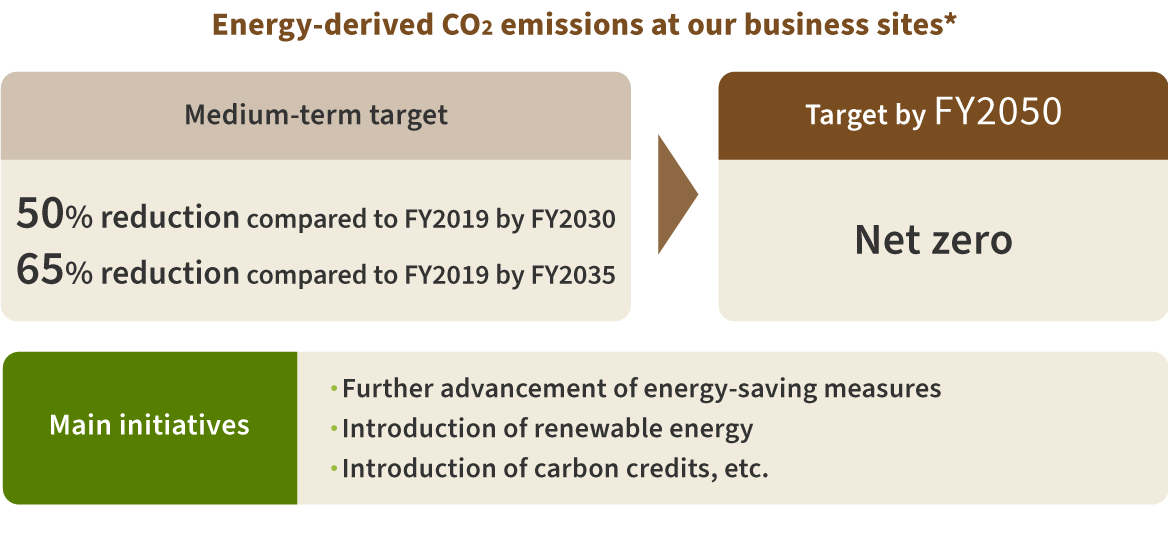
To evaluate and manage the progress of its ESG management and the impacts of policy risks on climate change, the Group has set GHG emissions as an indicator and has established interim milestones of reducing energy-derived GHG emissions at its sites by 50% by 2030 compared to fiscal 2019 and by 65% by 2035 compared to fiscal 2019. Furthermore, our target for 2050 is to reduce the amount of energy-derived GHG emissions (Scopes 1 and 2) at Group business sites (offices, own plants, directly operated amusement facilities, etc.) to net zero.
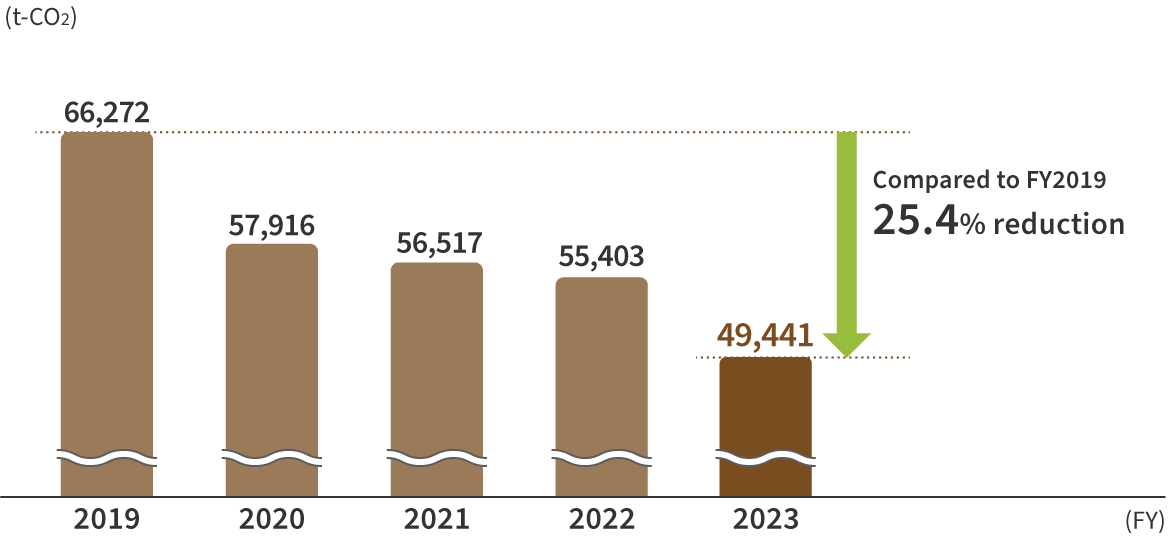
Note:Total of Scope 1 and Scope 2 emissions (Net emissions)
In addition to the above targets, the Group considers decarbonization throughout the entire supply chain (Scope 3) to be a key management issue. We will further promote engagement with our business partners, including our main suppliers, and proceed with discussions toward formulating and disclosing medium- to long-term reduction targets (including interim milestones) for Scope 3 emissions, which we currently calculate and disclose on an ongoing basis, with concrete timelines. These initiatives are being carried out in accordance with SSBJ standards.
Indicators for Resource Circularity and Environmentally Conscious Products
We manage indicators regarding the responsible use and disposal of plastics in each business under the Bandai Namco Group Plastic Environmental Consideration Policy. In particular, in terms of the collection of used plastics, the Gunpla Recycling Project has established a strong track record, collecting 37 tons of runners in fiscal 2024 and 47 tons through Gashapon Capsule Recycling. Recycled pellets made from collected empty capsules are used to make newly manufactured capsules at a ratio of approximately 40%. We continuously disclose quantitative progress regarding these resource circulation initiatives.
Targets and results by material issue: Our Materiality > Targets and results
Going forward, we will proceed with discussions toward developing quantitative indicators to show how our efforts to expand low-carbon and environmentally conscious products and services (e.g., the introduction of Eco-Amusement Machines and the development of sustainable products using alternative materials) will contribute to our revenue and profit growth in the future, and what scale of business they will represent within our business portfolio.
Addressing and Setting Targets for External Factors
The Group has identified climate change-related risks and opportunities, including policy and regulatory developments such as plastics and resource recycling regulations and the introduction of carbon pricing, as well as market trends such as changes in customer behavior. We are currently evaluating their significance and impact.
Achieving the targets of our Climate Transition Plan depends not only on our own efforts but also on external factors such as infrastructure development for plastic resource recycling, technological innovation in new materials, cleaner energy supply, and shifts in demand. The Group will continue to monitor these trends and, in response to challenges that may hinder the transition, will formulate action targets to address these challenges, taking into account the trends of industry associations and the initiatives in which we participate.